


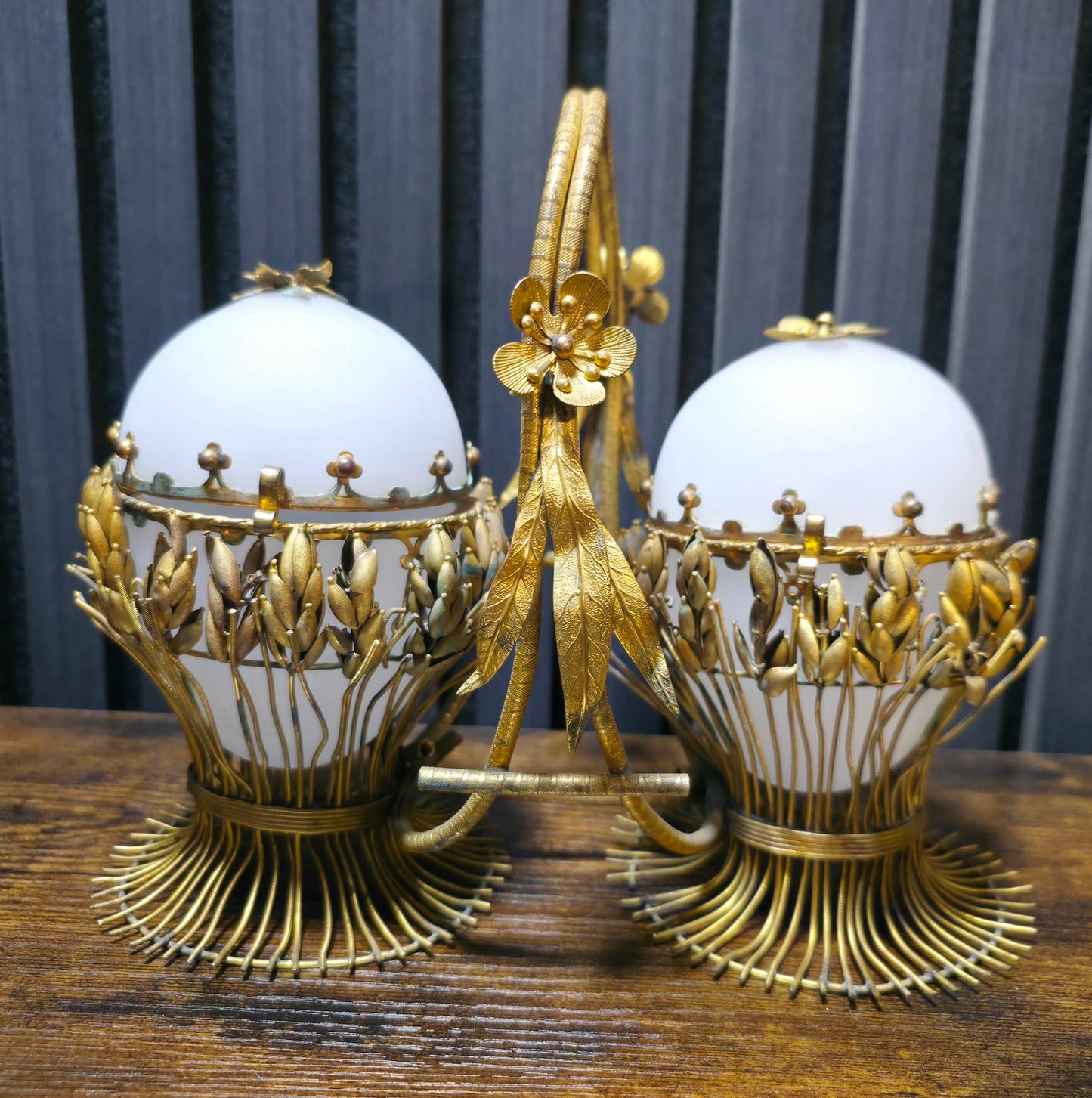
Antique French Napoleon III Opaline Glass Egg Bonbonnière Caddy, Gilt Wirework Wheat-Sheaf Basket, circa 1860–1880
Antique French Napoleon III Opaline Glass Egg Bonbonnière Caddy, Gilt Wirework Wheat-Sheaf Basket, circa 1860–1880
French School (Napoleon III Period, circa 1860–1880)
Bonbonnière Caddy of Two Egg-Form Hinged Boxes in White Opaline Glass, Set in a Gilt-Brass Wirework Wheat-Sheaf Stand.
[France], circa 1860–1880.
Medium and Support: Gilt brass (or bronze doré) wirework basket with cast naturalistic ornament; two white frosted opaline glass egg-form boxes hinged at the rim. The basket is formed of tightly bundled and splayed wirework simulating a sheaf of wheat or straw bound at center, enriched with applied cast sprays of grain heads and lance-shaped leaves in the round. An arched handle of braided twisted wire rises from the basket and terminates at the crown in a five-petal cast flower boss with bead center; trailing cast leaf sprays descend from the junction. Each opaline egg opens on a gilt-metal hinge and retains its white enamelled interior.
Format: Assembled caddy. Approximately 7 × 5½ × 5 inches overall (178 × 140 × 127 mm). Each opaline egg approximately 3 inches in diameter.
Condition: Good to very good. Gilt retains substantial warmth with characteristic toning and light surface oxidation consistent with age; no gilding losses noted. All four opaline eggs present and apparently intact; no chips or cracks observed. Hinges functional. Minor wear to wire-work extremities. No restorations detected.
A charming example of the luxury fancy goods (objets de fantaisie) produced in France during the Second Empire and Napoleon III period (1852–1870) and continuing into the early Third Republic. The bonbonnière — a small ornamental box for confectionery, comfits, or sweetmeats — was a staple of the Parisian luxury trade, retailed through the arcades of the Palais-Royal and the grands magasins of the Boulevard des Capucines. Egg-form opaline glass boxes mounted in gilt-metal stands were particularly fashionable during the 1860s and 1870s, combining the milky, opalescent quality of opaline glass — then at the height of its popularity in France — with the naturalistic ornament of the period.
The wheat-sheaf basket form is a recurring motif in French decorative arts of the Second Empire, drawing on the agrarian abundance imagery that pervaded the decorative vocabulary of the period, from Sèvres porcelain to bronze d'ameublement. The tightly bundled wirework splay at the base, the applied cast grain heads and leaves, the braided arched handle, and the cast flower boss at the crown are all characteristic of the Parisian objets de fantaisie workshops that supplied the bon-bon and étrenne (New Year's gift) trade. The paired two-egg configuration set in a single basket carrier is a typical and pleasing format, complete with both eggs present.
Couldn't load pickup availability
Share

Subscribe to our emails
Subscribe to our mailing list for insider news, product launches, and more.